Filter and sort 3 products
Sort by

Your Latest Loves

Kawase Hasui

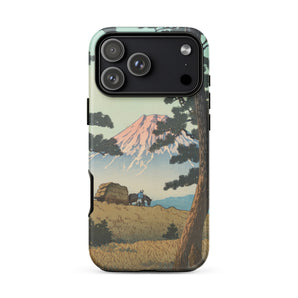
Kawase Hasui carried Japanese woodblock printing past its Edo inheritance into a new collaborative register. Publisher Watanabe Shozaburo built shin-hanga on shared labor: painter, carver, printer, each hand visible in one finished sheet. Hasui supplied the drawing. Carvers cut the line. Printers layered bokashi gradation, dusk bleeding into stone, snow settling on eave and lantern.

FAQs

About this collection

Taisho-era Japan watched its own countryside radically change under rail expansion and 1923 earthquake rebuilding. Hasui's prints held that scenery still: rain on a wooden bridge, snow on a temple roof, lantern light against blue-black water. Color built in transparent layers, paper left bare to carry fog or moonlight. Weather becomes the true subject, atmosphere standing in for topography.

A Hasui print marks the hinge between ukiyo-e's popular past and a printmaking market built for export and interior walls alike. Compositions favor a low horizon, wide sky, figures dwarfed by scale and season. Collectors of Japanese travel prints find rare middle ground here, popular craft made scholarly, scholarly craft made warm.

What is shin-hanga, and how did it depart from traditional ukiyo-e printmaking?

Shin-hanga (new prints) kept ukiyo-e's collaborative structure — designer, carver, printer — but aimed the results differently. Early 20th-century shin-hanga artists absorbed yōga, Western oil-painting instruction, and chased atmosphere: mist thinning over water, lantern glow bleeding into dusk. Kawase Hasui became one of the movement's most prolific designers, building scenes from natural light and shade rather than the flat color and bold outline of earlier woodblock schools.

Who was Kawase Hasui, and why is he a defining figure of 20th-century Japanese printmaking?

Hasui almost didn't become an artist — born Bunjirō Kawase in 1883, he was set to inherit his family's rope and thread business until its bankruptcy, at twenty-six, forced a change of direction. Teacher Kiyokata Kaburagi eventually accepted him as a pupil and gave him the name Hasui, water gushing from a spring. Over forty years he produced around 620 prints and was later named a Living National Treasure.

What was the working relationship between Kawase Hasui and publisher Watanabe Shōzaburō?

Hasui approached Watanabe in 1918, and three trial prints grew into full series by the following year. Watanabe's studio split the labor three ways — drawing, carving, printing — and Hasui described a successful print as requiring near-total agreement between designer and artisans, with an inexperienced printer wasting several trial proofs before one succeeded. The partnership outlasted even the 1923 destruction of Watanabe's workshop.

How did the 1923 Great Kantō earthquake affect Kawase Hasui's career?

The earthquake struck mid-series, destroying finished, undistributed woodblocks and 188 of Hasui's own sketchbooks stored at Watanabe's workshop. Rather than rebuild what was lost, Hasui spent 102 days traveling the Hokuriku, San'in, and San'yō regions — the longest trip of his life — returning in 1924 to develop an entirely new set of drawings. His color grew more vivid and his rendering more exacting afterward.

Why was Kawase Hasui named a Living National Treasure of Japan?

The honor almost took a different shape. In 1953 officials wanted to recognize Hasui for traditional printmaking, but since a finished print depends on a designer, engraver, and printer working in sequence, crediting one name raised objections. Their solution: commission a new print and document the full process — Hasui's Snow at Zōjō-ji was recorded across all forty-two print runs it took to complete. He received the title in 1956.

What distinguishes Kawase Hasui's prints from earlier ukiyo-e masters like Hiroshige and Hokusai?

Hiroshige and Hokusai worked largely in meisho — prints of famous, captioned places. Hasui, trained as a realist through yōga study, sought the opposite: quiet, minor locations urbanizing Japan was starting to overlook, rendered through observed light and texture rather than outline-and-caption convention. His first snow print, designed in 1920, shows the approach clearly — weather standing in for narrative, no text required.