Taguchi Tomoki's work revolutionized the centuries-old Japanese woodblock printing tradition, seamlessly blending with contemporary design. This modern master's work transforms everyday items into exquisite art pieces, each piece of Taguchi Tomoki's art telling a story of cultural heritage and artistic innovation.
FAQs
About this collection
What the hand carves, the spirit remembers. In the Taguchi Tomoki Collection, each line pressed into wood sings the ancient hum of Japanese woodblock printing, where ink meets fiber and silence learns to hold form.
Here, the woodblock crane unfolds its wings across a phone case, slender neck bridging earth and sky, while the black and white floral woodblock print blooms upon a cushion—petals stark against emptiness, like poetry without sound.
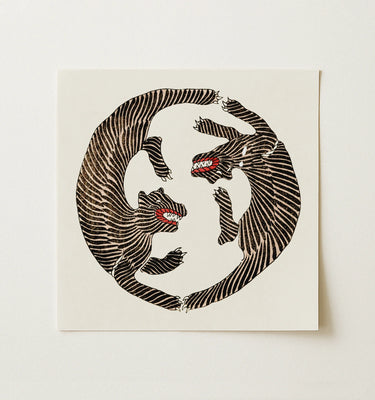
This is not decoration. It is Ukiyo-e’s ghost reborn, where the crane walks between worlds, the deer stands still enough to vanish, and woodblock tigers prowl the border between myth and memory.
Every print moves with the deliberate restraint of mokuhanga, the traditional process where nature’s shape emerges only after the wood surrenders. What you hold is not just a case or a cushion—it is a bridge, spanning Edo-period aesthetics and contemporary design, a quiet testimony to Japanese craftsmanship, where simplicity sharpens into elegance.
Even now, the wood remembers every cut, every grain, every fleeting image that passed through it—leaving behind a pattern that does not fade, only deepens.
From sleek phone cases adorned with graceful cranes to plush cushions showcasing intricate floral motifs, Tomoki's creations bridge the gap between functional objects and fine art. His woodblock prints, characterized by bold contrasts and clean lines, capture the essence of nature with a reverence that echoes through Japanese artistic history. Tomoki's tigers exude power, his deer embody elegance, and his flora burst with life, all rendered in the stark beauty of black and white.
This collection isn't just about owning art; it's about integrating the meditative process of traditional woodblock printing into daily life. Each piece serves as a tactile reminder of the enduring appeal of Japanese aesthetics, offering a moment of zen in our fast-paced world.
Tomoki's work stands as a testament to the timelessness of certain artistic elements - the fluidity of a crane's wing, the majesty of a tiger's stride, the delicate unfurling of a flower petal - all captured with a precision that honors the past while embracing the future.
Who was Taguchi Tomoki?
Taguchi Tomoki was a Japanese woodblock print artist active in the late 19th century during the Edo and early Meiji periods. He was known for his nature prints, especially of birds, plants, and other natural elements like the ocean. Some key facts about Taguchi Tomoki:
He created the woodblock print collection "Yatsuo no Tsubaki" between 1860-1869, which contains many nature prints and is his most well known work.
He had a simple and minimalist style, using muted tones and colors in his compositions. His prints often featured birds, flowers, trees, etc, designed into ornamental motifs.
He worked in the "bijinga" genre, depicting beautiful women in addition to nature scenes.
He was skilled at capturing natural objects like birds, plants, waves, etc. in an artistic way, blending Japanese and nature themes.
His work is considered significant for carrying on Edo period stylistic traditions into the Meiji period, despite the great societal changes happening in Japan at the time.
Original woodblock prints by Taguchi are collected, sold, and displayed around the world today as antique Japanese art.
In addition to Yatsuo no Tsubaki, some of his other known works are a blue and beige print titled "Birds Flying in the Blue Sky" and a print of seagulls.
What is Yatsuo no Tsubaki?
Yatsuo no Tsubaki is a famous woodblock print collection created by the Japanese artist Taguchi Tomoki between 1860-1869 during the late Edo and early Meiji periods. Some key points about Yatsuo no Tsubaki:
It is considered Taguchi Tomoki's most well-known and important work, containing many nature prints and ornamental designs.
The collection features simple, minimalist woodblock prints of birds, plants, trees, waves, and other natural elements arranged in artistic motifs and compositions.
Taguchi was skilled at capturing natural objects like birds and plants and integrating them into aesthetically pleasing designs with muted colors and tones.
The prints blend Japanese and nature themes, helping transition Edo period stylistic traditions into the Meiji era.
Original woodblock prints from the collection are now collected and sold around the world as antique 19th century Japanese art.
In addition to nature prints, Yatsuo no Tsubaki also contains some "bijinga" prints depicting beautiful women.
The collection has inspired modern reproductions, art prints, and products featuring its nature motifs.
What is Taguchi Tomoki's art style?
Simple and minimalist aesthetic using muted, soft colors and tones
Focus on natural subjects like birds, plants, trees, waves, etc
Natural elements arranged in ornamental motifs and compositions
Captured delicate details of birds, plants, feathers, waves, etc in an artistic way
Blended Japanese nature themes with simple, aesthetic designs
Used principles of harmony, balance, and calm in compositions
Smooth gradations of color rather than strong contrasts
White space and blank areas to highlight subjects
Traditional woodblock printmaking techniques with carving, inking, printing
Prints transitioned Edo period style into Meiji era despite societal changes.
What is the significance of Taguchi Tomoki's art?
Taguchi Tomoki's art holds significant historical and aesthetic value. His woodblock prints, characterized by their simplicity and natural motifs, offer a glimpse into the artistic sensibilities of the late Edo period in Japan. They provide a connection to the past and showcase the timeless appeal of traditional Japanese art.
What is mokuhanga?
Mokuhanga is the traditional Japanese woodblock printing method that uses carved wood blocks, water-based pigments, and hand pressure with a baren on washi paper. The technique took shape across the Edo period, with kento registration guiding multi-color impressions and natural materials shaping its crisp lines and tonal washes.
What does the crane mean in Japanese art?
The crane in Japanese art is a motif of longevity, fidelity, and good fortune drawn from classical poetry and seasonal imagery. Its tall stance and outstretched wings often mark auspicious scenes, wedding iconography, and New Year themes, linking nature, ritual, and graceful restraint.
I love this case! It’s beautiful! I’ve had it for about a month so far and have dropped my phone several times - my phone stayed in and the case is holding up well. The quality of the image isn’t grainy - you can see all the little details :)
Fabulous, Kellie! So pleased to hear your new treasure's guarding your phone in style. I love how fine the printing detail is, too — makes all the difference. Thanks a bunch for sharing your thoughts. Enjoy!
As always, brilliant work and brilliant service. The fastest service I’ve ever received by far from any artist—buy it, and it’s here within 5-7 days! This is my fifth purchase from Toby, and I’m waiting on a sixth. Tony is a magnificent artist and a magnificent business person. ✨✨✨✨✨
Huzzah! So happy to see the latest piece worked its magic like the rest, David. Your joy makes it all worth it for me. Thank you, thank you, thank you! ❤️
A classic image really well rendered in a large format. Arrived faster than expected, very well packed and in perfect condition.
Thanks Greg! Very happy to hear this print impressed like the others. Appreciate you taking the time to share. And here’s to your new treasure trove of daydream fuel… enjoy!
The artist captured the spirit of revelry and wild dance. A dancer, say, in the entourage of Dionysus. Sepia—old, say Renaissance (haven’t looked up the artist. The seller was knowledgeable, friendly, and the packaging was secure.
Huzzah! Thanks, James! Delighted you’re delighted and enjoyed our chats about art, design and Renaissance fairs. Look forward to helping you find more members of your retinue in the future.



 Black & White Florals - Taguchi Tomoki Phone Case From $48USD /🛎️ Made-to-order👁️ HD printed🌳 Plants a tree❤️ Satisfaction guaranteed
 Black & White Florals - Taguchi Tomoki Woodblock Print

 Black Swallow - Taguchi Tomoki Art Print
 Camellia - Taguchi Tomoki Art Print
 Ducks and Flowers - Taguchi Tomoki Art Print
 Flying Cranes - Taguchi Tomoki Art Print

 Graphic Bloom - Taguchi Tomoki Floral Art Print
 Graphic Bloom - Taguchi Tomoki Floral Phone Case From $48USD /🛎️ Made-to-order👁️ HD printed🌳 Plants a tree❤️ Satisfaction guaranteed
 Japanese Deer - Taguchi Tomoki Art Print
 Japanese Deer - Taguchi Tomoki Edo Art iPhone Case From $48USD /🛎️ Made-to-order👁️ HD printed🌳 Plants a tree❤️ Satisfaction guaranteed
 Japanese Woodblock Tiger - Taguchi Tomoki Phone Case From $48USD /🛎️ Made-to-order👁️ HD printed🌳 Plants a tree❤️ Satisfaction guaranteed
 Ornament I - Taguchi Tomoki Art Print
 Ornament II - Taguchi Tomoki Art Print
 Pair of Cranes - Taguchi Tomoki Art Print
 Pair of Swallows - Taguchi Tomoki Art Print
 Pair of Tigers - Taguchi Tomoki Art Print

 Red Peony - Taguchi Tomoki Art Print
 Red Peony - Taguchi Tomoki Phone Case From $48USD /🛎️ Made-to-order👁️ HD printed🌳 Plants a tree❤️ Satisfaction guaranteed
 Swallow and Butterflies - Taguchi Tomoki Art Print
 Twin Flame Phoenix - Taguchi Tomoki Art Print

 Wild Rose - Taguchi Tomoki Art Print
 Woodblock Crane - Taguchi Tomoki Art Print
 Woodblock Crane - Taguchi Tomoki Art Print
 Woodblock Crane - Taguchi Tomoki Bird Phone Case From $48USD /🛎️ Made-to-order👁️ HD printed🌳 Plants a tree❤️ Satisfaction guaranteed