Gekko's woodblock prints aren't mere depictions; they're portals to a realm where cherry blossoms dance with Western shadows, and Mount Fuji stands sentinel over a nation in flux. His scenes pulsate with a life force so potent, you can almost hear the soft sounds of kimono fabric and rustling bamboo leaves — feeling the mist rise from hidden mountain streams.
Gekko's genius lies in his alchemical fusion of Edo-period aesthetics with the encroaching influences of the Meiji era, creating a style that's as timeless as it is revolutionary. Each print is a masterclass in the art of negative space, where what's left unsaid speaks volumes, and every brushstroke is a love letter to the vanishing world of old Japan.
To own a Gekko is to possess a slice of history, a moment frozen in time when Japan stood on the precipice of modernity, captured by an artist whose vision spanned centuries. These aren't just woodblock prints; they're windows into a soul of a nation, rendered with a precision that would make a watchmaker weep and a poetry that could move mountains.
What blooms between dusk and the first tremor of dawn, when ink forgets its edges and silence learns to shimmer? Ogata Gekko walks there—in the fragile twilight between Edo’s closing breath and Meiji’s fevered hunger—where Kacho-ga swallows the air, and chrysanthemums open their veins onto silk.
Each Ukiyo-e print is more than a picture, it's a threshold: the ghost of a folding screen collapsing into the modern gaze. In Gekko’s hands, woodblock prints learn the language of light—Western chiaroscuro rupturing the flat serenity of uki-e landscapes, while courtesans drift through transient worlds, half shadow, half song.
This collection gathers that impossible archive—Meiji period tension pressed into paper, the brush tracing memory along the spine of tradition. Kimono-clad figures haunt these compositions, rendered with a precision that devours itself, both delicate and relentless, embodying the fleeting beauty of mono no aware. Cherry blossoms bruise the sky, herons stitch the river, and each frame remembers what Japan forgot in its rush toward modernity.
To hold these designs is to cup life in your hands—ephemeral, essential, eternal. When you turn away, they remain: a glint of gold leaf in the corner of your eye.


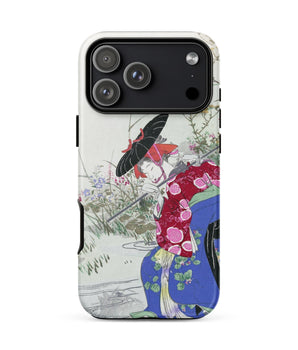 Fox Spirit - Ogata Gekko Ukiyo-e Phone Case $48USD /🛎️ Made-to-order👁️ HD printed🌳 Plants a tree❤️ Satisfaction guaranteed
 Kabocha Ni Tonbou - Ogata Gekko Ukiyo-e Phone Case $48USD /🛎️ Made-to-order👁️ HD printed🌳 Plants a tree❤️ Satisfaction guaranteed
 Moonlight and Pine Trees - Ogata Gekko iPhone Case $48USD /🛎️ Made-to-order👁️ HD printed🌳 Plants a tree❤️ Satisfaction guaranteed