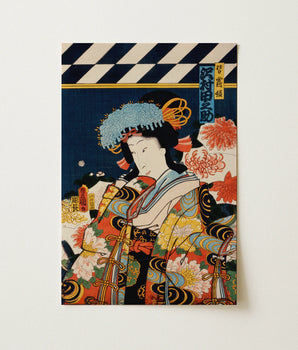
Toyohara Kunichika

Filter and sort 2 products
Product Type
Subject
Style
Color
Origin
Medium
Sort by

Your Latest Loves

Toyohara Kunichika

Toyohara Kunichika, born Ōshima Yasohachi in 1835, was a Japanese woodblock print artist known for his vivid depictions of kabuki actors and beautiful women (bijinga). A student of Utagawa Kunisada, Toyohara Kunichika mastered the yakusha-e genre, capturing the drama of Edo period theater while adapting to the Meiji era's cultural changes.

FAQs

About this collection

Kunichika's bold use of strong reds and purples, made possible by new aniline dyes, set his work apart. His portraits of kabuki actors conveyed dynamic energy and emotional depth, bringing characters to life. He also created elegant bijinga, blending traditional ukiyo-e with a modern sensibility.

Despite personal challenges, Kunichika remained dedicated to his craft, producing works celebrated for their innovation. His ability to merge traditional techniques with modern influences made him a vital link between the Edo and Meiji periods. Today, Kunichika is remembered as one of the last great ukiyo-e masters, whose vivid colors and dynamic compositions continue to inspire.

Why do some art historians consider Kunichika a significant bridge figure between the Edo and Meiji periods?

He carried Edo-period ukiyo-e traditions successfully into the vastly different Meiji era of industrialization and Western contact — a continuity contemporaries and modern scholars alike have recognized as a genuine achievement given how completely photography and photoengraving destroyed most other ukiyo-e careers during the same transition.

How did Toyohara Kunichika signal "modernity" within a fundamentally traditional art form?

Though rooted in his teachers' Edo-period style, he experimented with Western vanishing-point perspective and pioneered the bold use of imported German aniline-dye reds and purples — colors contemporaries associated symbolically with the progress and enlightenment of Japan's new Western-facing era.

How did Kunichika's own artist name reflect his artistic lineage?

"Kunichika" was a composite name deliberately combining those of his two teachers, Kunisada and Chikanobu — a naming convention that publicly announced his dual artistic inheritance within the influential Utagawa school.

Why are yakusha-e (kabuki actor prints) considered historically significant beyond simple portraiture?

These prints functioned as the era's primary form of theater advertising and celebrity culture — Kunichika's close-up "large-head" actor portraits captured kabuki stars mid-performance for a public that had no photography or film to record fleeting stage moments, making his prints a rare surviving record of specific 19th-century theatrical performances.

What does Kunichika's focus on kabuki subject matter reveal about Edo-period urban culture?

Ukiyo-e as a genre existed to document and celebrate the "floating world" of urban pleasure — theater, courtesans, and fashionable city life — and Kunichika's deep personal immersion in that world, as a self-described backstage regular who partied with actors and geisha, gave his theatrical prints an insider's authenticity rare even among his ukiyo-e peers.

Why did Toyohara Kunichika's reputation collapse in the West for most of the 20th century?

Influential collector Arthur Davison Ficke's 1915 book Chats on Japanese Prints dismissed his work as "degenerate" and blamed him for "the final ruin of the art of color prints" — a single, harsh judgment from an early tastemaker that shaped American collecting preferences for decades and buried Kunichika's reputation until recent scholarship began correcting the record.