Dive into the vivid, sun-drenched world of Paul Gauguin, the audacious French post-impressionist who swapped Parisian salons for Tahitian shores. This collection showcases Paul Gauguin's bold break from European artistic traditions. Revel in his lush, adventure-inspired tableaux, where reality and myth intertwine like vines in a tropical forest.
FAQs
About this collection
Gauguin's paintings pulse with primal energy, each brushstroke a rebellion against convention. "The Big Tree" stands as a towering testament to nature's raw power, while "Day of the God" plunges viewers into a mystical Polynesian dreamscape. These masterpieces now adorn notebooks, art prints, and iPhone cases, bringing Gauguin's exotic visions to your everyday life.
Immerse yourself in Gauguin's daring use of non-naturalistic color and simplified forms. His work, a sensual feast of ochres, ceruleans, and verdant greens, captures the essence of French Polynesia's intoxicating allure. This collection invites you to escape the mundane and embrace the wild, untamed spirit of post-impressionism.
What made Gauguin a pioneer of modern art rather than just another Post-Impressionist?
His development of Synthetism — flattened forms, bold unmediated color, and pattern over realism — fed directly into Symbolism, Fauvism, and eventually Picasso's early Cubist breakthroughs, making him a hinge figure between 19th-century painting and 20th-century modernism.
Was Gauguin's "primitive paradise" real or invented?
Invented, and Gauguin knew it. His most famous Tahitian scenes often combine European art-historical references, photographs he carried with him, and imagined "exotic" details rather than documenting what he actually witnessed — a bowerbird-like collage of sources dressed up as authentic Pacific life.
Did Paul Gauguin invent his own persona?
Largely, yes. He carefully shaped how the public saw him — presenting himself as an untutored free spirit who painted without preparation, even when preparatory sketches for major works like Where Do We Come From? What Are We? Where Are We Going? proved otherwise.
What was Gauguin's relationship with Vincent van Gogh really like?
Intense and combustible — the two painted side by side in Arles for nine weeks, admired each other's theories deeply, and clashed badly enough that Gauguin's abrupt departure preceded the night Van Gogh severed his own ear.
Why did Gauguin's fame arrive only after his death?
He sold work for modest sums and was largely dismissed by critics and collectors during his lifetime; it wasn't until a major 1906 Salon d'Automne retrospective, three years after he died, that he was recognized as a defining figure of Primitivism and Post-Impressionism.
Why do people call Paul Gauguin "problematic" today?
Because his art and his biography can't be separated from colonialism — major exhibitions now explicitly interrogate his self-created myth of the "savage artist," reading his Tahitian work against the backdrop of postcolonial critique rather than treating it as untouched paradise-painting.
I love this case! It’s beautiful! I’ve had it for about a month so far and have dropped my phone several times - my phone stayed in and the case is holding up well. The quality of the image isn’t grainy - you can see all the little details :)
Fabulous, Kellie! So pleased to hear your new treasure's guarding your phone in style. I love how fine the printing detail is, too — makes all the difference. Thanks a bunch for sharing your thoughts. Enjoy!
As always, brilliant work and brilliant service. The fastest service I’ve ever received by far from any artist—buy it, and it’s here within 5-7 days! This is my fifth purchase from Toby, and I’m waiting on a sixth. Tony is a magnificent artist and a magnificent business person. ✨✨✨✨✨
Huzzah! So happy to see the latest piece worked its magic like the rest, David. Your joy makes it all worth it for me. Thank you, thank you, thank you! ❤️
A classic image really well rendered in a large format. Arrived faster than expected, very well packed and in perfect condition.
Thanks Greg! Very happy to hear this print impressed like the others. Appreciate you taking the time to share. And here’s to your new treasure trove of daydream fuel… enjoy!
The artist captured the spirit of revelry and wild dance. A dancer, say, in the entourage of Dionysus. Sepia—old, say Renaissance (haven’t looked up the artist. The seller was knowledgeable, friendly, and the packaging was secure.
Huzzah! Thanks, James! Delighted you’re delighted and enjoyed our chats about art, design and Renaissance fairs. Look forward to helping you find more members of your retinue in the future.


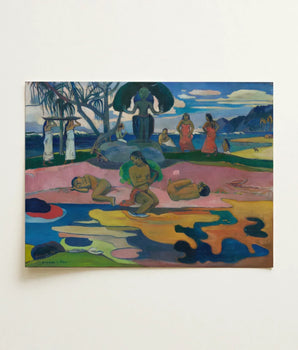 Day of the God - Paul Gauguin Art Print
 Day of the God - Paul Gauguin Phone Case
 The Big Tree - Paul Gauguin Art Print
 The Big Tree - Paul Gauguin Phone Case