Embark on a journey through the captivating world of Japanese Meiji period art, where East meets West in a dazzling fusion of tradition and innovation. This transformative restoration era, spanning from 1868 to 1912, witnessed a seismic shift in expression. And this Meiji period art captures the moment when Japan flung open its doors to global influences after centuries of isolation.
FAQs
About this collection
The yōga style, championed by the Meiji government, ushered in a renaissance of Western-inspired techniques, while the enduring legacy of Chinese aesthetics continued to weave its magic through the fabric of Japanese creativity. Picture vibrant woodblock prints bursting with newfound subjects – from the spectacle of foreign customs to the grim reality of global warfare – each image a window into a rapidly modernizing society. Curious about that Chinese influence? Start with Chinese art.
Meiji portraits, once bound by tradition, now pulsed with fresh vitality, capturing the essence of a nation in flux. As artists deftly navigated this cultural crossroads, they birthed a visual language uniquely their own, blending time-honored motifs like auspicious cranes and mythical dragons with bold new perspectives.
The result? A mesmerizing tapestry of art that not only reflected Japan's journey towards modernity but also solidified its place on the world stage, forever altering the course of artistic history and leaving an indelible mark on the global cultural landscape.
Why is the Meiji period considered a pivotal turning point in Japanese art history rather than simply an era of Western imitation?
Recent scholarship, including the "Meiji Modern" exhibition thesis, deliberately challenges the long-standing narrative that Meiji art was merely derivative — arguing instead that objects like lacquerware and cloisonné combined Euro-American techniques with deep-rooted Japanese and Chinese traditions to create a genuinely distinct form of non-Western modernity.
What is the difference between yōga and nihonga, and why does that division matter to Japanese art history?
Yōga ("Western-style painting") fully embraced French painting traditions from the Barbizon School to Impressionism, while nihonga ("Japanese painting") deliberately reinvented native traditions like the Kanō and Rinpa schools rather than simply reviving or rejecting them — together the two movements represent parallel, competing responses to the same crisis of national artistic identity.
Why did international expositions become central to how Meiji Japan defined its own art?
Beginning with the well-received 1862 London and 1867 Paris exhibitions, Japan's new imperial government deliberately used the international appetite for Japanese decorative arts to help offset the country's steep economic costs of modernization, extending this strategy through further expositions in Vienna, Philadelphia, and Chicago.
Why is Meiji-era woodblock printing considered a technical departure from earlier ukiyo-e, rather than simply new subject matter?
Meiji artists and printers actively minimized the thick outlines and simple color blocking typical of earlier ukiyo-e, introducing softer palettes, one-point perspective, and atmospheric depth borrowed from Western painting — a genuine technical evolution visible in prints like Kobayashi Kiyochika's celebrated 1895 imperial train station triptych.
Why does the introduction of aniline synthetic dyes matter to identifying and understanding Meiji-era prints?
Newly available synthetic aniline dyes gave Meiji prints a distinctively bright, saturated color palette unlike the more muted vegetable-based pigments of earlier eras — a technical shift that remains one of the clearest visual markers collectors and historians use to date and identify work from this specific 44-year period.
Why do art historians consider Kawanabe Kyōsai one of the most historically important artists of the Meiji transition?
Straddling both the Edo and Meiji periods, Kyōsai is credited with producing Japan's first manga magazine in 1874 and is considered the country's first political caricaturist — using his signature blend of the popular and the elite to satirize major Meiji reforms like compulsory education, all while directly influencing manga and tattoo art today.
I love this case! It’s beautiful! I’ve had it for about a month so far and have dropped my phone several times - my phone stayed in and the case is holding up well. The quality of the image isn’t grainy - you can see all the little details :)
Fabulous, Kellie! So pleased to hear your new treasure's guarding your phone in style. I love how fine the printing detail is, too — makes all the difference. Thanks a bunch for sharing your thoughts. Enjoy!
As always, brilliant work and brilliant service. The fastest service I’ve ever received by far from any artist—buy it, and it’s here within 5-7 days! This is my fifth purchase from Toby, and I’m waiting on a sixth. Tony is a magnificent artist and a magnificent business person. ✨✨✨✨✨
Huzzah! So happy to see the latest piece worked its magic like the rest, David. Your joy makes it all worth it for me. Thank you, thank you, thank you! ❤️
A classic image really well rendered in a large format. Arrived faster than expected, very well packed and in perfect condition.
Thanks Greg! Very happy to hear this print impressed like the others. Appreciate you taking the time to share. And here’s to your new treasure trove of daydream fuel… enjoy!
The artist captured the spirit of revelry and wild dance. A dancer, say, in the entourage of Dionysus. Sepia—old, say Renaissance (haven’t looked up the artist. The seller was knowledgeable, friendly, and the packaging was secure.
Huzzah! Thanks, James! Delighted you’re delighted and enjoyed our chats about art, design and Renaissance fairs. Look forward to helping you find more members of your retinue in the future.

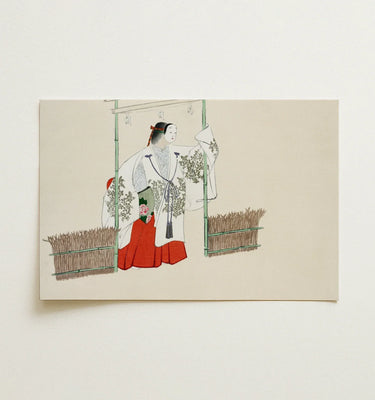


 An Actor Applies Makeup in his Dressing Room - Arai Yoshimune Art Print
 Art Supplies - Kamisaka Sekka Meiji Art Print

 Autumn Evening - Kamisaka Sekka Art Print
 Autumn Hills - Kamisaka Sekka Art Print
 Birds - Kamisaka Sekka Winter Migration Art Print
 Blossoms - Kamisaka Sekka Art Print

 Blossoms from Momoyogusa - Kamisaka Sekka Art Print
 Buggering the Russian Art Print
 Butterflies - Kamisaka Sekka Cho Senshu Art Print
 Cattails and Moon - Shibata Zeshin Art Print
 Chrysanthemums - Kamisaka Sekka Art Print
 Cranes from Momoyogusa - Kamisaka Sekka Art Print

 Daikyokubam Japanese Circus - Meiji Era Art Print
 Dancers from Momoyogusa - Kamisaka Sekka Art Print
 Deer - Kamisaka Sekka Woodland Forest Art Print
 Dog and Snail - Kamisaka Sekka Kacho-e Art Print

 Elk - Kono Bairei Meiji-era Nihonga Deer Art Print
 Embroidered Fukusa - Meiji Era Textile Art Print
 Evil Spirit - Aoi no Ue, Tsukioka Kogyo Art Print
 Fan - Kamisaka Sekka Japanese Meiji Art Print
 Fireflies at Ochanomizu - Kobayashi Kiyochika Art Print
 Flower Boat - Kamisaka Sekka Art Print
 Flower Wagon - Kamisaka Sekka Woodblock Art Print
 Flowers from Momoyogusa - Kamisaka Sekka Art Print
 Flute Player - Kamisaka Sekka Meiji Period Art Print
 Flute Player and Ox - Kamisaka Sekka Art Print
 Forest illustration - Watanabe Seitei Shin Bijutsukai Art Print