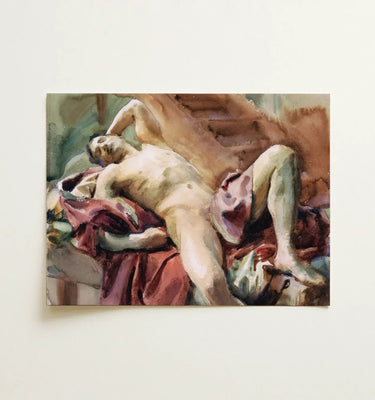
Male nude art is the oldest exercise in looking. A model climbs onto the stand, the room goes quiet, and every artist present starts negotiating with a shoulder. Some models sat for the money, some for the artist, and a few clearly for themselves. Painters like William Etty and John Singer Sargent spent whole careers in that room. This is gay nude art without the act: skin, weight, light and the long pause before anyone dresses. Each male nude print keeps the body as the whole subject, whether it was drawn two centuries ago or last week.
FAQs
About this collection
The nude didn’t stay in the studio for long. Once the camera arrived, photographers such as Wilhelm von Gloeden carried the figure study outdoors, into sunlight and ruins, and it has never quite come back inside. Black and white, sepia or hand-tinted, the subject stayed the same: a man, unhurried, letting himself be seen.
Some artists, Egon Schiele among them, turned the mirror on themselves. Others, like Henry Scott Tuke, followed swimmers down to the water. Gay male nude art has always moved between the studio and the shore, and this male nude artwork keeps room for all of it: charcoal academies, oil nude paintings, chalk studies, figure photographs, and new nudes by Toby Leon made in the same tradition. Symbolists like Sascha Schneider and Magnus Enckell pushed the male body toward myth.
In Ancient Greece, the naked male form stood for triumph, glory, and moral excellence — the male body was seen as a canvas for the character traits a society prized most: power, courage, and self-mastery. That symbolic weight carried forward for over two thousand years, making the male nude one of art history's most loaded and enduring subjects.
Why did Ancient Greek artists idealize the male nude?
Physical beauty was linked to inner goodness in Greek philosophy, so sculptors built increasingly lifelike, athletic bodies that doubled as moral portraits. Some historians also connect the chiseled, armor-like musculature of these figures to Greece's militarized culture, where a soldier's physique and a soldier's virtue were treated as one and the same.
How did the meaning of the male nude change from the Middle Ages to the Renaissance?
Medieval Christian culture linked nakedness to Original Sin, so the confident, naked bodies of Antiquity gave way to slighter, more modest figures with little emphasis on naturalism. The Renaissance reversed that shift entirely: fueled by the rediscovery of classical statues and by humanist philosophy's new regard for earthly life, the naturalistic, toned male body returned as the pinnacle of artistic skill and an arena for anatomical study.
Which artists are most associated with reshaping the male nude?
Michelangelo and Caravaggio anchor the classical tradition, while later figures broke from it in radically different directions: Egon Schiele and Lucian Freud pursued raw, unidealized bodies, David Hockney folded tenderness and homoeroticism into brightly lit domestic scenes, and Robert Mapplethorpe used stark black-and-white photography to make the body's sexuality explicit rather than implied.
What's the difference between the classical male nude and the modern male nude?
The classical nude is muscular, composed, and flawless by design — a body built to look invulnerable. Modern and contemporary artists have pushed back against that mold since the late 19th century, favoring fleshy, imperfect, fragmented, or emotionally exposed bodies that reject the old idea of a single "ideal" male form.
Why is the male nude significant in queer and LGBTQ+ art history?
Because the male body was already coded as an object worthy of admiration, it became fertile ground for artists exploring homoerotic desire once cultural taboos began loosening — from the coded intimacy of 19th-century bathing and athletic scenes to Mapplethorpe's confrontational photography and Kehinde Wiley's reworking of classical portraiture through a contemporary Black queer lens. Museum exhibitions have even devoted entire wings to this theme, tracing the male nude's shift from an emblem of heroic virtue to an explicit object of desire.
I love this case! It’s beautiful! I’ve had it for about a month so far and have dropped my phone several times - my phone stayed in and the case is holding up well. The quality of the image isn’t grainy - you can see all the little details :)
Fabulous, Kellie! So pleased to hear your new treasure's guarding your phone in style. I love how fine the printing detail is, too — makes all the difference. Thanks a bunch for sharing your thoughts. Enjoy!
As always, brilliant work and brilliant service. The fastest service I’ve ever received by far from any artist—buy it, and it’s here within 5-7 days! This is my fifth purchase from Toby, and I’m waiting on a sixth. Tony is a magnificent artist and a magnificent business person. ✨✨✨✨✨
Huzzah! So happy to see the latest piece worked its magic like the rest, David. Your joy makes it all worth it for me. Thank you, thank you, thank you! ❤️
A classic image really well rendered in a large format. Arrived faster than expected, very well packed and in perfect condition.
Thanks Greg! Very happy to hear this print impressed like the others. Appreciate you taking the time to share. And here’s to your new treasure trove of daydream fuel… enjoy!
The artist captured the spirit of revelry and wild dance. A dancer, say, in the entourage of Dionysus. Sepia—old, say Renaissance (haven’t looked up the artist. The seller was knowledgeable, friendly, and the packaging was secure.
Huzzah! Thanks, James! Delighted you’re delighted and enjoyed our chats about art, design and Renaissance fairs. Look forward to helping you find more members of your retinue in the future.



 Anzacs Bathing - George Washington Lambert Art Print
 Study of a Nude Man - August Andreas Jerndorff Art Print
 Beach Study - Henry Scott Tuke Art Print
 Boys on the Beach - Ferenczy Karoly Art Print
 Japanese Wabori Tattoo - S. Ogawa Art Print
 A Bathing Group - Henry Scott Tuke Art Print
 Male Figure in Repose - Gaudenzio Marconi Art Print
 Seated Male Nude (Self-Portrait) - Egon Schiele Art Print
 Seated Male Nude (Self Portrait) - Egon Schiele Art Print
 Study of a Male Nude - Edward Francis Burney Fine Art Print
 Study of Adam for Paradise - Alexandre Cabanel Art Print
 Fisherman with a Net - Frederic Bazille Art Print
 Bathers at Rest - Paul Cézanne Art Print
 Male Nude Seen from Behind - Ubaldo Gandolfi Art Print
 Dying Adonis - Magnus Enckell Art Print
 Study of a Male Model - Albert Edelfelt Art Print
 Lament - Anton Kolig Art Print
 Gold Star - Gay Indian Neoclassical Art Print
 Self Portrait Holding a Nude Study - Luis Egidio Melendez Art Print
 Male Torso in Profile - Theodore Gericault Art Print
 Male Nude - Theodore Gericault Art Print
 Study of a Nude Man - Follower of Pierre Narcisse Guerin Art Print
 Manlius Hurled from the Rock - William Etty Art Print
 The Wrestlers - William Etty Homoerotic Art Print
 Nude Man Tying His Sandal - William Etty Art Print
 Bacchant - Magnus Enckell Nude Art Print
 Dante and Virgil - William-Adolphe Bouguereau Art Print